
When Diplomacy Can No Longer Protect Even Children, We Must Ask Where We Are Heading
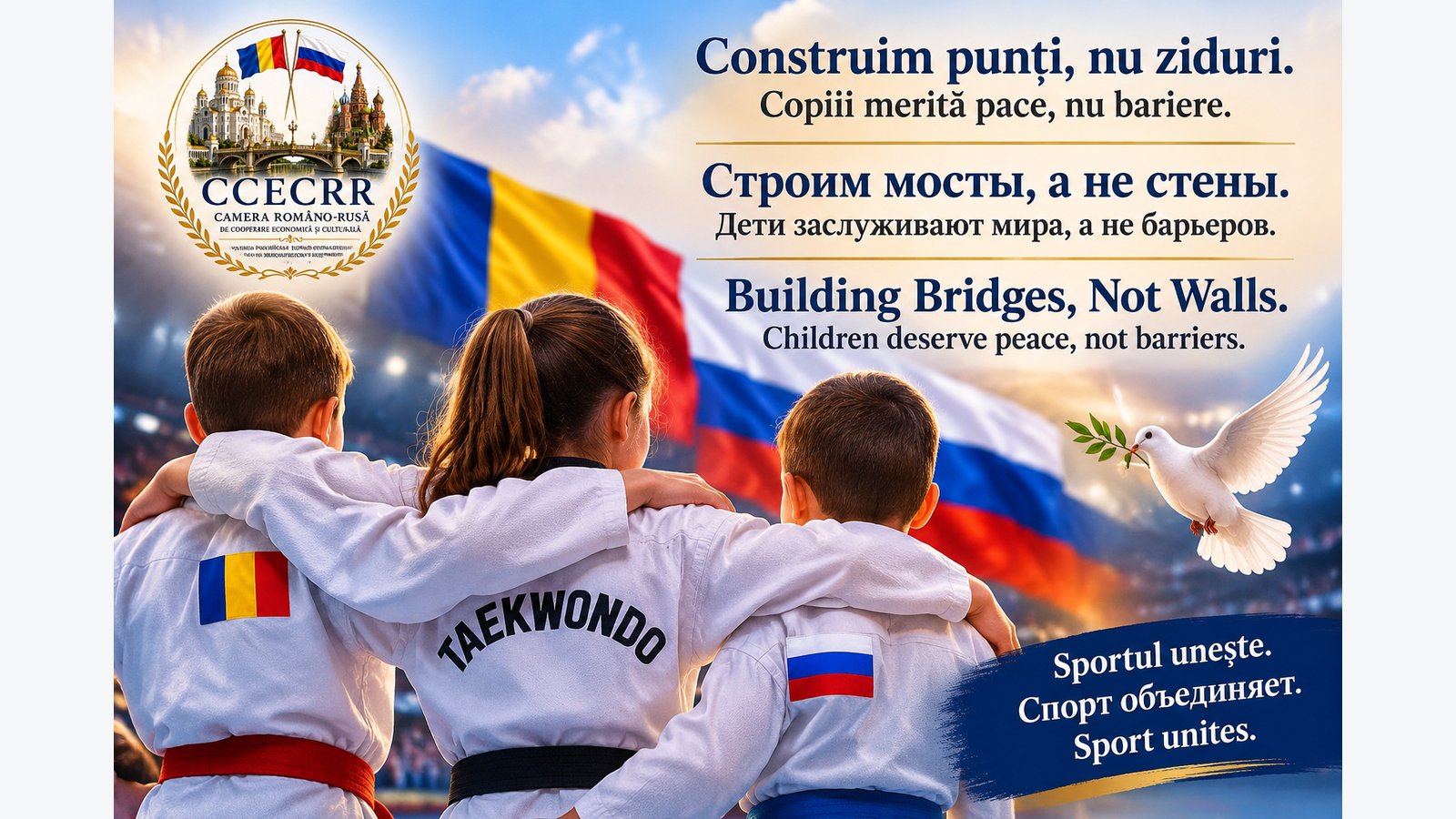
CCECRR stands in solidarity with young athletes and affirms that children must never pay the price of conflicts between states.
The Romanian-Russian Chamber of Economic and Cultural Cooperation expresses its profound sadness and disappointment at the Romanian authorities’ decision to refuse visas to young athletes from the Russian Federation, aged between 12 and 14, who were expected to participate in the European Taekwondo Championships scheduled to take place in Bucharest in late November 2026.
It is regrettable that, in a Europe which speaks so often of peace, solidarity, human rights and the protection of children, we are witnessing situations in which children themselves bear the consequences of political confrontations they did not cause and over which they have no influence.
We are not speaking about politicians, military personnel or individuals involved in making decisions on behalf of a state. We are speaking about children. Young people who have spent years in training halls, learning discipline, respect for their opponents and the joy of victories earned through hard work.
Behind each of them stands a family, a coach, sacrifices and hopes. For an adult, the refusal of a visa may be an administrative procedure. For a twelve-year-old child, however, it may mean losing one of the most important experiences of their childhood.
We ask ourselves what we can tell these children. That their hard work was in vain? That they are not welcome because of relations between governments? That a sporting competition, which should be a place of respect and human encounter, has become yet another arena of political confrontation?
We believe that such a situation does not reflect well on Romanian diplomacy.
The Romanian-Russian Chamber of Economic and Cultural Cooperation has always supported Romania’s right and duty to protect its security, national interests and international commitments. We understand that the current geopolitical context is complex, that profound political differences exist and that the Romanian state must make responsible decisions.
Yet it is precisely under such circumstances that diplomacy must demonstrate its true value.
Closing a door is relatively simple. Finding a solution that respects the law, safeguards security and, at the same time, prevents children from becoming victims of conflicts they did not cause is far more difficult.
This is precisely the effort we would have expected from Romanian diplomacy.
We do not believe Romania becomes stronger when children are unable to participate in a sporting competition. We do not believe a country’s prestige grows through the disappointment of young people who bear no responsibility for the political decisions of adults.
On the contrary, we believe the true strength of a state lies in its ability to remain fair, balanced and humane even in difficult circumstances.
Romania has an important diplomatic tradition. Nicolae Titulescu understood that peace is not something achieved once and for all, but an ongoing responsibility requiring dialogue, patience and sustained effort. Diplomacy does not exist merely to engage with those who agree with us, but above all to find channels of communication when relations between states become difficult.
Today, however, we increasingly witness diplomatic instruments being transformed into mechanisms of isolation and exclusion. Instead of seeking solutions, we erect new barriers. Instead of keeping channels of communication open, we accept their gradual closure. And when the consequences of such decisions begin to affect children, we must have the courage to ask whether we have moved away from the very purpose of diplomacy.
The history of international sport offers important lessons. The Olympic Games scheduled for 1940 and 1944 were cancelled because of the Second World War, while during the Cold War political boycotts deprived numerous athletes of the opportunity to compete in events for which they had prepared for years.
Romanian history also offers an example of dignity and independence in decision-making. In 1984, Romania participated in the Los Angeles Olympic Games despite the boycott imposed by most countries of the Soviet bloc. It was a moment when our country demonstrated that sporting participation could be separated from political confrontation and that independent decisions could be taken in a deeply polarized international environment.
It would be regrettable if, more than four decades later, we forgot that lesson.
We cannot maintain that sport unites nations only when that principle is convenient. We cannot speak of the Olympic spirit, respect and fair play while unreservedly accepting the exclusion of children from a sporting competition as a consequence of tensions between states.
Furthermore, the jurisprudence of the Court of Arbitration for Sport in Lausanne has shown that blanket restrictions on athletes’ participation may conflict with the rules and principles governing international sport. In the dispute between the Table Tennis Federation of Russia and the European Table Tennis Union, the tribunal annulled certain participation restrictions. In December 2025, in proceedings concerning the International Ski and Snowboard Federation, CAS likewise intervened against certain general prohibitions.
These rulings do not override states’ powers regarding visas and security, but they remind us that exclusion should not become an automatic response and that every measure must be assessed responsibly and proportionately.
At the same time, the United Nations Convention on the Rights of the Child establishes the best interests of the child as a primary consideration in decisions affecting children. This principle does not displace the laws governing entry into a country, but it requires us not to treat the consequences for children as a mere administrative detail.
We want these principles to have genuine meaning, rather than remaining attractive phrases in official statements.
A child who bows to an opponent before a taekwondo match sometimes offers a lesson in respect that adults would do well to observe more closely.
On the sporting field, children learn that one can have an opponent without having an enemy. That one can lose without hatred and win without humiliation. That respect does not depend on the language one speaks, the place where one was born or political relations between states.
Perhaps these are precisely the lessons that should be more present in contemporary diplomacy.
The President of the Romanian-Russian Chamber of Economic and Cultural Cooperation, Tudor Afanasov, stated:
“I look at this situation first and foremost as a human being and as a parent, not merely from the perspective of our international cooperation activities. I think of these children who prepared for the competition, of their emotions, of the parents who encouraged them and the coaches who believed in them.
It saddens me that Romania, the country where they should have been welcomed as participants in a European competition, has instead become a closed door for them.
I am Romanian, and I want to be proud of my country’s diplomacy. I want a Romania that is respected, secure and strong, but also a Romania capable of showing humanity when circumstances are difficult.
I am not asking anyone to ignore security concerns or abandon the principles of the Romanian state. I do believe, however, that genuine diplomacy begins precisely when, instead of settling for a refusal, we try to find a solution.
We do not have to agree with a government’s decisions in order to respect children. We do not have to share the same political views to meet on a sporting field. And we should not turn every political disagreement into another barrier between people.
I wonder what these children will tell their classmates about Romania when they return to school. I would have liked them to speak about Bucharest, about the athletes they met, about a wonderful competition and about the friendships they made here.
I wish Romania had given them that memory.
I believe Romanian diplomacy can do better. And precisely because I respect my country, I want it to be known for the bridges it builds, not the doors it closes.
If diplomacy can no longer build bridges even for children, then we have serious reasons to ask whether we have moved away from its true purpose.”
The Romanian-Russian Chamber of Economic and Cultural Cooperation considers the refusal to allow these young athletes to participate a deeply regrettable decision whose consequences extend beyond a simple administrative procedure. It affects children, Romania’s image as a host of international competitions and confidence that sport can remain a space of mutual respect even during periods of political tension.
We do not consider national security and the protection of children’s interests to be incompatible objectives. On the contrary, the responsibility of professional diplomacy is precisely to find the appropriate balance between them.
We express our solidarity with the young athletes affected, their families and their coaches. We wish to convey to them that Romania is more than an administrative decision and that there are people in Romanian society who respect them, appreciate their dedication and would have liked to see them compete alongside the other participants.
Equally, our solidarity extends to all children affected by wars, international tensions and political decisions. We do not and will not distinguish between children on the basis of nationality, origin or citizenship. To us, before anything else, they are children, and their suffering, hopes and dignity deserve equal consideration and respect.
No child should bear responsibility for the political decisions of adults. No child should become an instrument of diplomatic pressure or a collateral victim of confrontation between states.
We established the Romanian-Russian Chamber of Economic and Cultural Cooperation in the conviction that relations between peoples must not be reduced to relations between governments. Economic cooperation, cultural exchanges, education and sport are bridges that should be preserved even when political dialogue passes through difficult periods.
We do not know how long the current international tensions will last. We do know, however, that they will not last forever and that, when the time comes to rebuild relations, it will matter whether we had the wisdom to keep at least some bridges open.
Romania must remain firm in defending its interests, but that firmness must not cause us to lose respect for people, the ability to engage in dialogue or a sense of proportion.
We want Romanian diplomacy to be something we can be proud of: diplomacy capable of defending the interests of the state while protecting human dignity.
We do not need diplomacy that demonstrates how many barriers it can erect. We need diplomacy that shows how many obstacles it can overcome.
And when children are involved, that responsibility is even greater.
Children did not cause conflicts between states. They did not choose political confrontations, and they should not be the ones who pay the price. They are children, before anything else, and deserve to be treated as such.
Building bridges, not walls.
Press Office
Romanian-Russian Chamber of Economic and Cultural Cooperation
office@ccecrr.ro
www.ccecrr.ro